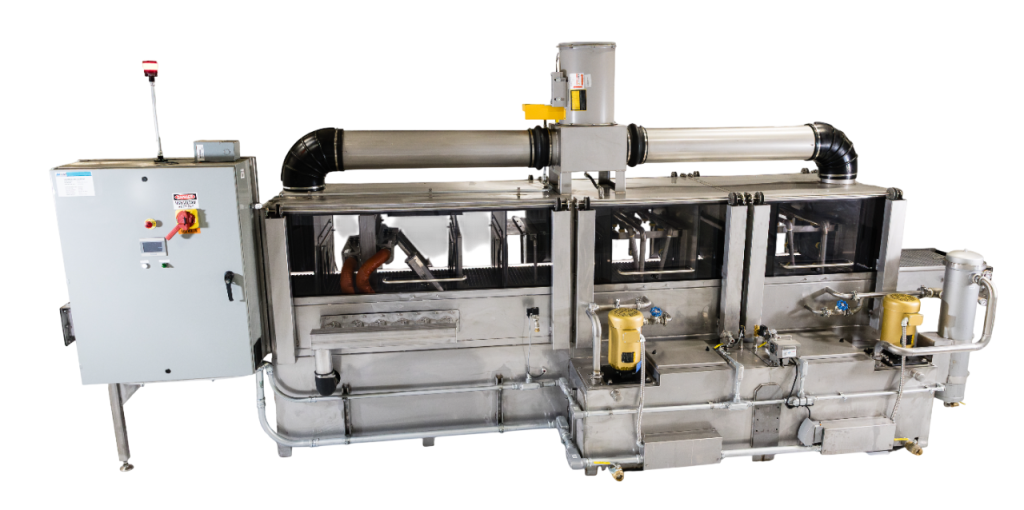
Inline builds heated aqueous spray washers that remove oil, grease, chips and dirt with water-based detergent instead of solvent. Every machine runs on a closed-loop system that filters and reuses the wash solution, so you use less water, detergent and energy. Each washer is engineered to your parts, contaminants and throughput.
How Our Aqueous Washers Clean
A pump pushes heated cleaning solution through a bag filter and out through spray nozzles aimed at your parts. The solution drains off the parts, back into the tank, is filtered and used again. Cleaning performance comes from five things we set for your application:
| Variable | What we set |
|---|---|
| Temperature | Most aqueous washers run between 140 and 160°F (60 to 70°C). Higher temperatures help with heavy oils or baked-on contaminants. |
| Pressure | Industrial spray washers typically run between 40 and 120 psi (3 to 8 bar), higher when needed. |
| Time | Zone length and line speed give the detergent enough contact time. Typically detergents need between 10 and 30 seconds of contact time to dissolve oils; however, less or more time may be required depending on the application. |
| Chemistry | Detergent matched to your contaminants and part material. |
| Filtration | Filters sized based on your cleanliness requirements. |
Heating Options
| Heat source | Best for |
|---|---|
| Electric immersion heaters (standard) | Small and medium washers. Efficient, inexpensive and controllable heat with minimal losses. |
| Gas burners | Large tanks of 400+ gallons, temperatures above 160°F, or when electric demand must be kept low. |
| Steam heat | Plants with spare steam from a central boiler. We supply a shell and tube heat exchanger and its own circulation pump. |
Built to Cut Water, Detergent and Energy Use
- Closed-loop wash system recirculates and filters the solution to extend bath life
- Rinse water cascades back into the wash zone where appropriate
- Oil skimmers (belt or coalescing type) remove floating oil to extend bath life
- Insulated tanks, sealed enclosures and right-sized pumps reduce heat loss and power draw
- Halo rinse with DI or RO water for spot-free parts, drained into the rinse zone for reuse
Aqueous vs Solvent Cleaning
| Aqueous (water-based) | Solvent-based | |
|---|---|---|
| Fire risk | Aqueous: Low flammability risk | Solvent: High flammability risk depending on the solvent |
| Operator exposure | Aqueous: Fewer hazardous fumes, minimal PPE | Solvent: More fumes, more PPE |
| Environment | Aqueous: Lower VOCs, often biodegradable, many detergents drain-safe where codes allow | Solvent: Tightly regulated, higher disposal costs |
| Materials | Aqueous: Works on steel, aluminum, plastics and rubber | Solvent: Check compatibility for each material |
| Best use | Aqueous: High-volume production cleaning of stamped, machined and assembled parts | Solvent: Specialty applications |
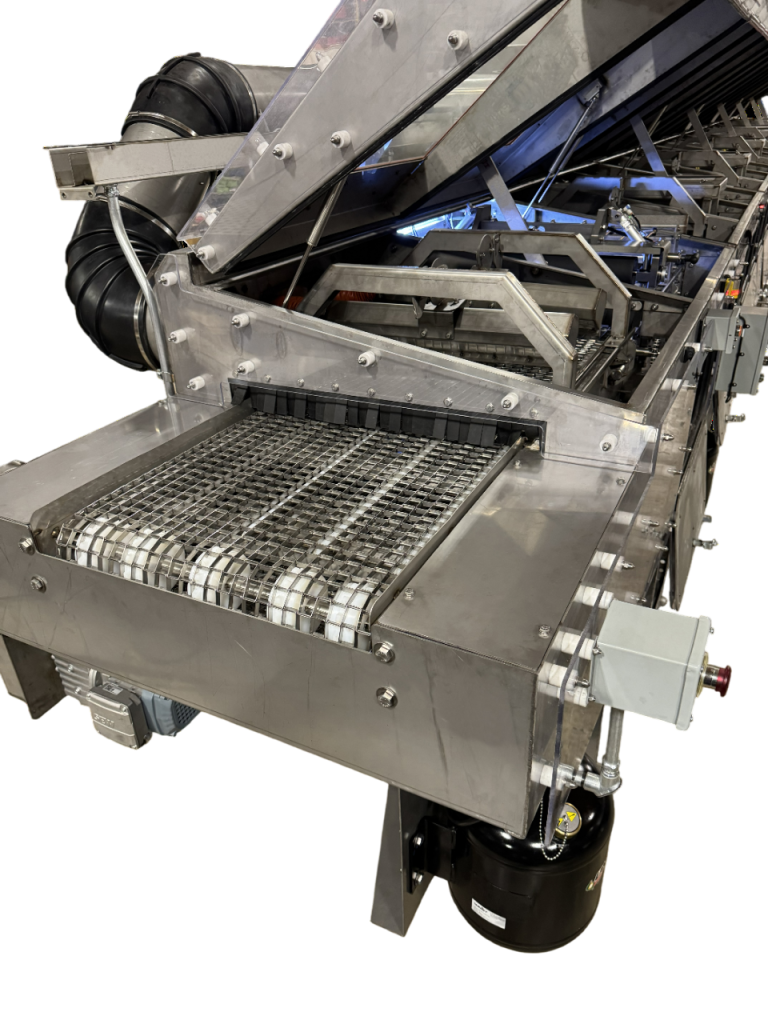
Aqueous spray washing is what every Inline machine is built around.
Aqueous Washers We Build
For continuous high-volume cleaning
With robot or pick-and-place loading
For complex parts with internal features that require a small, circular footprint
For seed boxes and dunnage
For geometries requiring the nozzles or part to move inside the wash process
Swipe to see all 5 →
Detergent Selection and Cleaning Trials
The right chemistry matters as much as the machine. We help you choose a detergent for your contaminants, part materials and water quality, and can recommend trusted suppliers. We can also run cleaning trials on your sample parts at our facility to confirm the chemistry and process before we finalize the design.
Frequently Asked Questions
What is an aqueous parts washer?
An aqueous parts washer cleans parts with hot water and water-based detergent sprayed under pressure. The solution is filtered and reused in a closed loop, which extends bath life and reduces water and detergent use.
What temperature should an aqueous washer run at?
Between 140 and 160°F (60 to 70°C) is the most common range. Lower temperatures can cause detergent foaming, while higher temperatures are sometimes needed for stubborn oils or baked-on contamination. The best setpoint depends on your detergent and contaminants.
Does aqueous cleaning remove heavy oil and grease?
Yes, with the right temperature, detergent and contact time. For heavy oils we often run hotter wash solution and add oil skimming so removed oils do not build up in the tank.
Is aqueous cleaning better than solvent cleaning?
For most production cleaning, yes. Water-based detergents carry less fire and fume risk, lower VOCs and work on more materials. Solvent systems still suit some specialty jobs.
How is oil removed from the wash solution?
Disc or belt oil skimmers pull floating oil off the tank surface, working best when the solution is still, such as during shift changes. Coalescing oil skimmers are needed when the washer runs continuously or removes a high volume of oils. Filtration only removes solids such as metal chips.
How do you dispose of used wash solution?
It depends on your local rules. Many aqueous detergents can be drained into a sanitary sewer where permitted. If disposal via sanitary sewer is not permitted due to local regulations, the solution can be evaporated before disposal via a licensed waste handler. We can recommend equipment to extend bath life and reduce disposal volume.
Talk to an Engineer About Your Parts
Share your parts, contaminants and cleanliness spec, or send sample parts for a cleaning trial. We will recommend the washer type, temperature and heating that fit your line.